The Word Mapping Formula
Learn the Mathematical Formula for Mapping Words Bidirectionally

Supporting Teachers to Know the Code and Show the Code.
The Word Mapping Formula shouldn’t be a secret.
Teachers deserve the knowledge, tools and autonomy to SHOW the Code at the point of need.
To find out what teachers need, we do need to take them through the Phonological–Orthographic Mapping (POM) Checks.
We know it might feel like a 'test', but it's designed to identify the training you haven't previously received and to empower you.
We aren't telling teachers how to teach students.
Knowledge and Autonomy. Not More Programmes
Teachers need the knowledge, professional autonomy and tools to understand how their children are learning, recognise what they already know, identify what they need next and make informed instructional decisions.
Rather than depending on prescribed programmes to tell them what to teach and when, teachers should be equipped to respond to the individual children in front of them.
That means moving away from one-size-fits-all training for teachers, too! We need to understand what teachers already know, identify what they need next and provide targeted professional learning that builds their knowledge, confidence and autonomy.
The Teacher Test of Phonological–Orthographic Mapping (POM) is being designed to assess whether teachers can identify the phonemes in spoken words and map them to the corresponding graphemes.
It's a test of how well teachers have been prepared through their training, not a judgement of their competence or how they teach phonics.

Knowledge and Autonomy. Not More Programmes
Supporting teachers to SHOW the Code at the point of student need.
Teachers need the knowledge, professional autonomy and tools to make instructional decisions themselves, rather than depending on directions written by people who don't know their pupils.
Teachers are the people who see children learning every day. They observe their responses, recognise their struggles, celebrate their progress and understand their individual needs.
Yet increasingly, teachers are expected to deliver prescribed programmes, follow predetermined sequences and demonstrate fidelity to approaches developed by people who have never met the children in their classrooms.
What if we shifted the focus from following programmes to understanding learners?
What if teachers had the knowledge, confidence and tools to identify what each child already knows, understand what they need next and respond immediately?
That's the paradigm shift we're advocating.
Teachers need knowledge, not more instructions.
A programme can provide structure, introduce foundational skills and offer useful resources.
But a programme cannot know every child.
It cannot anticipate every difficulty, every question or every opportunity for learning that arises throughout the school day.
Teachers need to understand how reading and spelling develop, how speech and print connect, and how children acquire the orthographic knowledge that enables increasingly independent reading and spelling.
They need to recognise when a child requires explicit instruction, what needs to be shown and when that child is ready to move forward.
As much explicit instruction as they need, and no more.
That requires professional knowledge and judgement, not simply fidelity to a programme.
What is Mark Seidenberg telling us?
In his April 2026 article, The “Too Much Phonics” Question, reading researcher Mark Seidenberg questioned how much explicit instruction children need, for how long and at what stages of their development.
His concern is not with phonics itself, but with instructional approaches that risk extending explicit teaching beyond the point at which children can begin learning more independently.
He emphasises that explicit instruction should enable implicit learning, with children increasingly acquiring knowledge through reading, writing and language experiences.
In May 2026, When Learning Only Has To Be “Good Enough”, he explained that beginning decoding procedures are the starting point for learning to read, not the endpoint.
Children need sufficient foundational knowledge to begin developing the rapid, increasingly automatic word recognition characteristic of skilled reading.
In June 2026, Seidenberg also questioned the expectation that experienced teachers demonstrate strict fidelity to prescribed curricula, particularly when this limits their opportunities to exercise professional judgement.
His concerns raise an important question.
If children need different amounts of explicit instruction, how can teachers determine what each child needs when they're expected to follow the same programme and sequence?
This is where teacher knowledge and professional autonomy become essential.
The people writing the programmes don't know your pupils.
In October 2026, Dr Andy Johnson made a closely related argument in Blanche DuBois and the Reading Messiah that Wasn't.
He distinguishes between teachers who understand reading and make informed decisions, and those who have been left dependent on following instructions in a manual.
His central point is that teachers know their pupils, their contexts and their teaching situations. But to act on that knowledge, they also need a strong understanding of reading, learning and pedagogy.
Without that professional knowledge, important instructional decisions are effectively transferred to the people writing the programmes.
Teachers shouldn't have to depend on someone else's instructions to decide what the child in front of them needs.
They should be equipped to make those decisions themselves.
Are we giving teachers what we're expecting them to use?
Education departments expect teachers to support children in connecting speech and print for reading and spelling.
But are initial teacher education, professional development and phonics programmes providing a sufficiently clear and consistent understanding of how words map bidirectionally?
Are teachers being shown how to apply that knowledge beyond the words and correspondences explicitly included in their programmes?
And are they being given the tools to respond when a child needs support at a different point in their learning?
These are questions about the quality, clarity and usefulness of the support teachers receive, not questions about whether teachers are trying hard enough.
We cannot expect teachers to demonstrate knowledge they haven't been given opportunities to develop.
And we shouldn't confuse programme completion with evidence that individual children have received what they need.
From following a programme to understanding the learner.
Imagine an approach in which teachers have the knowledge and autonomy to respond to what a child is showing them.
Instead of asking, What's next in the programme?, they can ask:
-
What does this child already understand?
-
What are they showing me through their reading and spelling?
-
What knowledge is missing?
-
What do they need me to SHOW them?
-
How much support will help them move forward independently?
The focus moves away from delivering the same instruction to everyone and towards making informed decisions about individual learning.
The goal isn't less support for children. It's better-targeted support, provided when it's needed.
This also means giving teachers the confidence to evaluate programmes critically, recognise what they do and don't provide, and adapt instruction rather than treating programme content as the limit of what can be taught.
Technology should support professional autonomy, not replace it.
The Bidirectional Word Mapping Formula and Ortho-GraphiX® technology within MyWordz® have been developed to make the connections between speech and print visible.
The purpose isn't to introduce another prescribed teaching programme.
It's to give teachers access to information they can use whenever they need it, including when children encounter words beyond those explicitly taught.
Teachers can use that information to SHOW the Code, support reading and spelling, examine children's word mapping and decide what further instruction might be useful.
The technology doesn't need to tell teachers what to teach next.
It gives teachers the information to make that decision themselves.
It's Not a Test. It's a Deep Dive into Teacher Support.
We're exploring whether teachers are receiving the knowledge, guidance and practical support needed to apply bidirectional word mapping throughout the school day.
We want teachers to participate because their experiences matter.
We want to understand what they've been taught, which aspects of their training have been useful, where information may be unclear or contradictory, and what would help them feel more confident and independent.
This isn't about judging teachers.
It's about examining the support they're receiving and identifying what needs to change.
The insights can help inform teacher education, professional development and the resources teachers need to respond confidently to individual learners.
Knowledge and Autonomy. Not More Programmes.
We need to move beyond asking whether teachers are following a programme and start asking whether they have the knowledge and support to understand what their children need.
Teachers deserve professional autonomy.
Children deserve teachers who can respond to their individual learning needs.
And both deserve a system that values understanding over compliance.
Don't give teachers another programme to follow. Give them the knowledge, autonomy and tools to make informed decisions for the children in front of them.
If we expect teachers to SHOW the Code, we must understand how they make decisions and what they believe, not only which programme they've used.
Emma Hartnell-Baker MEd SEN

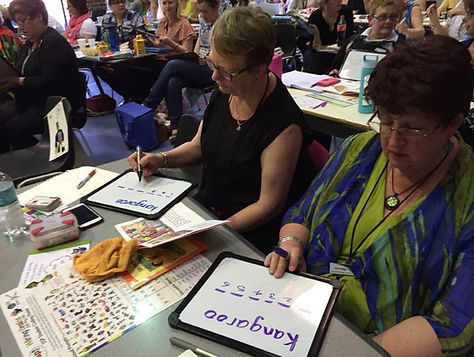
Ask about Teacher Testing, Training and Support to Show the Code using the Word Mapping Formula