The Word Mapping Formula
Learn the Mathematical Formula for Mapping Words Bidirectionally
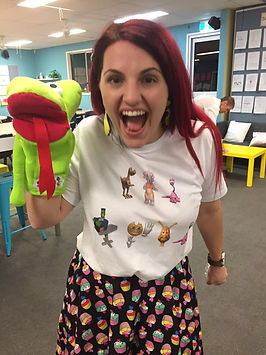
Bidirectional Word Mapping Training for Educators and SALTS
Don't be fooled by the fun, playful nature of the Phonemies®. They don't just appeal to children in the early years and teachers who love to play. Students learning to read and spell can still have fun in KS2 and KS3 because Phonemies® make the code finally make sense. That feels good! Especially if they've struggled to understand synthetic phonics programmes.
Emma Hartnell-Baker designs for need, not age or grade. Much of her work came into existence after working with disengaged teenage boys, many of whom had been permanently excluded from school.
Ask about Word Mapping Mastery® training in 2027, either face-to-face or online.

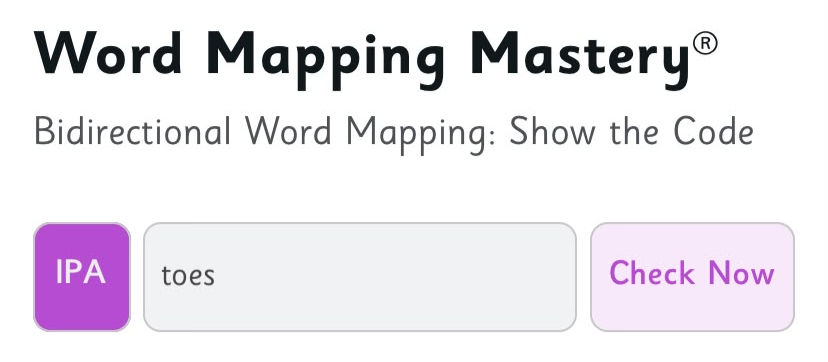

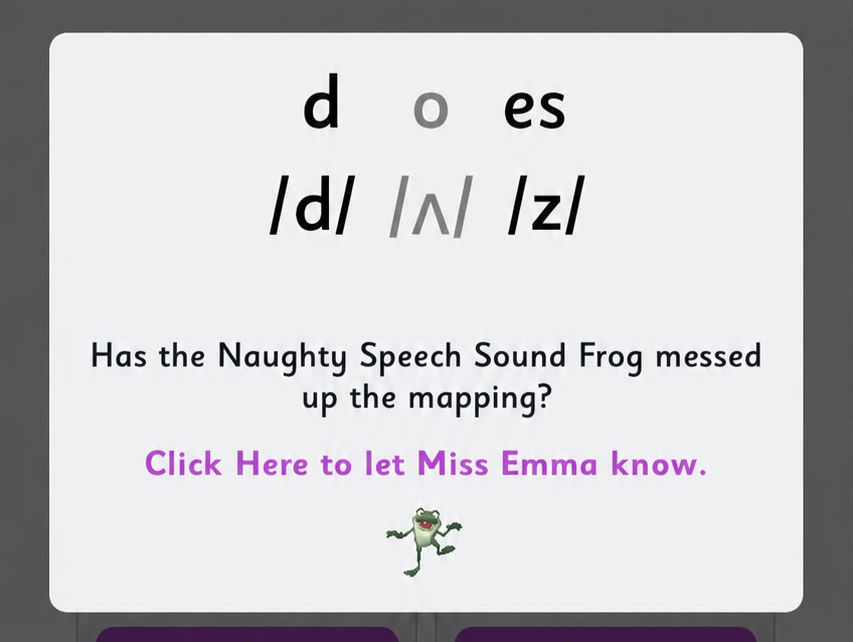

Learn the Word Mapping Formula, how to use the Word Mapping Tool and the 60-Second Spelling Routine.
Adults receive as much explicit instruction as THEY need. They don't need to be experts in linguistics or morphology to ensure that every child receives the explicit instruction the DfE expects teachers to provide, including being shown how the phonemes in spoken words correspond to the graphemes in written words for reading and spelling.
In reading, pupils are taught to decode by identifying graphemes in written words from left to right, saying the corresponding phonemes, and blending those phonemes to say the whole word (Department for Education, 2023, p. 47).
In spelling, pupils are taught to say a word clearly, segment it into phonemes, and select graphemes to represent each phoneme in writing (Department for Education, Writing Framework, 2025, p. 41). Statutory spelling guidance further states that teachers should draw pupils’ attention to grapheme–phoneme correspondences that both do and do not fit with what has been taught so far (Department for Education, Spelling Framework, p. 75).
The DfE expects teachers to extend programmes and apply phonics to all words, in all year groups, so that children continue to learn correspondences that have not yet been taught. So there is a clear gap between what synthetic phonics programmes teach and the code knowledge needed to read and spell words in KS1 and KS2, let alone KS3 and KS4. To learn the whole alphabetic code children need to transition into the self-teaching phase quickly and easily in KS1 and read for pleasure.
Self-teaching occurs when learners use their existing grapheme–phoneme knowledge to decode unfamiliar written words independently. Each successful decoding experience provides an opportunity to bond the word's spelling, pronunciation and meaning in long-term memory through orthographic mapping, making future recognition increasingly automatic.
The goal of explicit instruction is therefore to equip learners with the knowledge and skills they need to become self-teaching, reducing their dependence on adult support for reading and spelling.
The missing link to improved literacy for all has been teacher knowledge and access to Show the Code tools. Adults need to be able to show learners how the phonemes and graphemes correspond in every word, and teach them to use the 60-Second Spelling Routine to bond the spelling, pronunciation and meaning in the orthographic lexicon. The goal is for learners to become self-teaching, recognising words automatically when reading and spelling them correctly without relying on adult support.
By giving teachers what THEY need to support decoding and encoding at the point of need, for ALL words, regardless of their morphological structure or the child's accent, we can bridge the learning gap.
Furthermore, this system can be used by ALL educators, as the bidirectional word mapping technology does the technical work for them. Teachers develop their own word mapping knowledge simply by using the technology, without needing further explicit instruction themselves after the initial training.
Emma Hartnell-Baker MEd SEN
Advocate for Self-Paced Orthographic Learning (SPOL) with MyWordz® Bidirectional Word Mapping Technology
WordMappingFormula.com


When adults attend Word Mapping Mastery® training, they learn how to use The Word Mapping Formula, The Word Mapping Tool and The 60-Second Spelling Routine.
These are used whether a learner is 3, 13 or 30, because the goal is to ensure that they become self-teaching and that reading and spelling become easier. It's never too late! However, it's far easier to prevent the need for intervention, so please do follow the Upstream Team at UpstreamSEND.com. We've just been awarded over £200,000 in funding to get the ball rolling towards screening all three-year-olds for dyslexia risk and providing support upstream. First Ripple SEN Support! Ask about Specialist Word Mapping Training and join us as a Dys-Code® Assessor.